Online Piano Lessons for Adults: What Actually Works
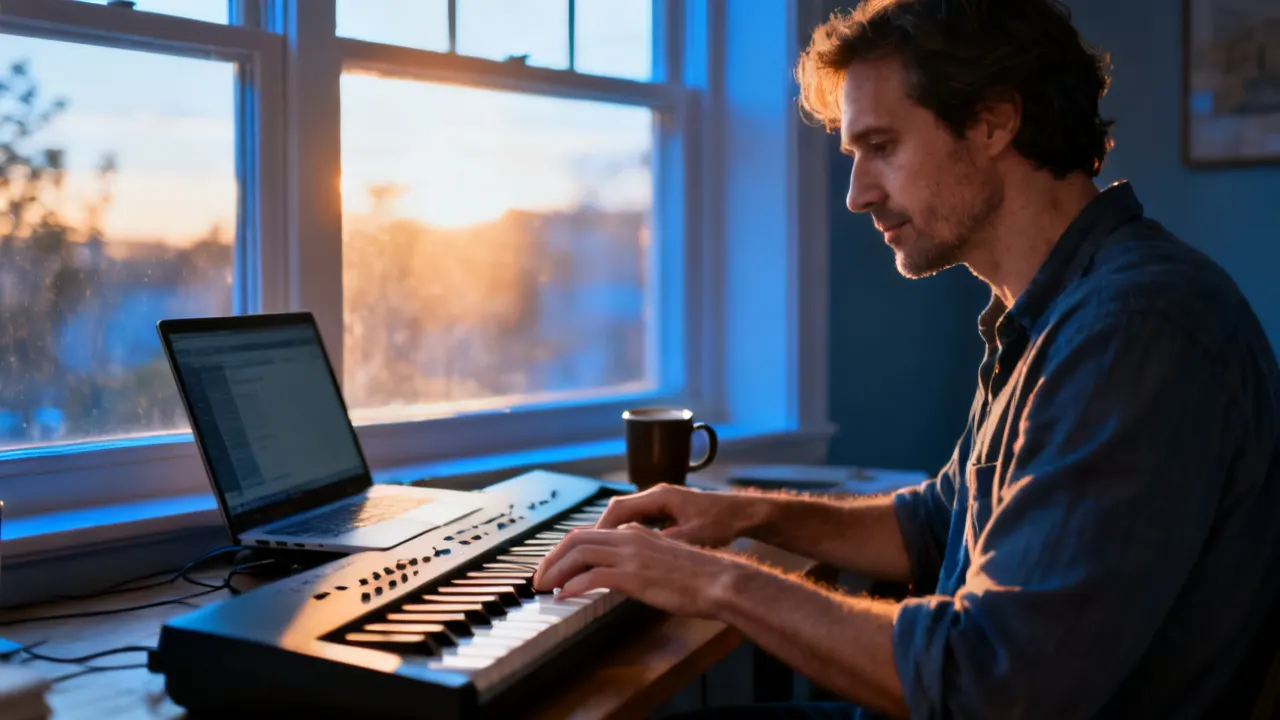
Online piano lessons for adults work well when you match the format to your personality and your calendar. You no longer have to commute to a studio or schedule a weekly slot around work. You can learn at 6 a.m. or 10 p.m., in your pajamas, at a pace that suits you. The challenge is that there are now so many options that choosing becomes its own project. This guide sorts them into three types, shows what each does best, and gives you a simple setup and schedule.
Three ways to learn piano online
Live video lessons with a teacher
You and a teacher meet on a video call. They watch your hands through a camera, hear you play and adjust the next steps. This is the closest thing to in-person lessons.
Best for: people who want accountability, personal feedback and a human relationship with the instrument.
Watch out for: cost, fixed schedules, and camera angles. Ask the teacher how they see your hands, because a view from the front is much less useful than a view from above or the side.
Recorded video courses
A course is a series of pre-recorded lessons, often with downloadable sheet music. You move at your own pace. Strong courses have a clear order and short chapters.
Best for: self-starters who like depth on a method and do not need external deadlines.
Watch out for: lack of feedback and the temptation to binge-watch rather than practice. Pause the video and play every time.
Guided apps
A guided app asks about your level and goals, builds a plan, and walks you through short daily activities. Keyora is built this way: a quick quiz about your experience and the time you have, then a personalized path with courses, a songbook and challenges. For a longer look at features to compare, read our checklist for choosing a piano app.
Best for: busy adults who want structure without a fixed appointment.
Watch out for: apps that gamify without teaching music. Check that songs and real playing are central.
A comparison at a glance
| Format | Flexibility | Feedback | Structure | Cost level |
|---|---|---|---|---|
| Live video teacher | Low to medium | High | High | Highest |
| Recorded course | High | Low | Medium to high | Medium |
| Guided app | Highest | Low to medium | High | Lowest per month |
Use this table as a starting point. Many learners start with an app or course for daily habits and add a monthly live lesson once they have something to show.
Your home setup in 20 minutes
You do not need a studio. You need a corner.
- Instrument: a digital piano or keyboard, ideally with 61 or more keys. Weighted keys feel closer to an acoustic piano, but unweighted keys are fine to begin.
- Seat: a stable bench or chair. Your elbows should be roughly level with the keys, with your feet flat on the floor.
- Screen: place your tablet or laptop on the music stand or just behind the instrument so you can see it without craning your neck.
- Sound: headphones for private practice. For live lessons, check your audio settings so the teacher hears the piano clearly.
- Light: a lamp that lights the keys without glare on the screen.
- Camera: if you take live lessons, angle your camera so the teacher sees your hands from above or the side.
Leave everything set up. A keyboard that needs assembly each day will not get played.
A weekly schedule that fits adult life
Here is a template for someone with limited time.
- Monday, Wednesday, Friday: 15 minutes. New material from your course or app.
- Tuesday, Thursday: 10 minutes. Review, rhythm and a song you enjoy.
- Saturday: 20 minutes. Play through everything from the week, record yourself.
- Sunday: rest, or play for fun.
If your week is chaotic, reduce it to five minutes on the hard days. The aim is to keep the thread unbroken. For more templates read our piano practice routine guide.
How to make online learning stick
Play along, not just watch. For every minute of video, spend at least a minute at the keyboard. Stop the video to try each new idea.
Use a visible timer. It makes starting easier because you know when you are done.
Set one goal per week. "Play the first line of a song smoothly" is clearer than "get better".
Record yourself. Hearing a playback shows you things you cannot notice while playing, like uneven rhythm.
Join a community if you like company. A forum, a study group or a friend learning alongside you adds accountability.
What online lessons cannot do
Be honest about the limits so you can plan around them.
- A recorded lesson cannot see your hand shape. Look up basic technique and check your wrists and finger curvature on video once in a while.
- Apps cannot replace a live musician for ensemble playing or advanced interpretation.
- Self-paced formats make it easy to drift. Build external cues, like reminders.
If you ever feel pain in your hands or wrists, stop and consult a professional before continuing.
A first session, step by step
Your first online session sets the tone, so make it easy. Sit down at the keyboard with your device on the stand and headphones on. Spend the first two minutes just finding middle C and playing the white keys up and down, naming each one aloud. Spend the next five minutes on whatever your lesson shows first, pausing the video after each instruction to try it. Finish with two minutes of playing anything you like, even a single note held for a long time, to listen to the sound. Close by writing one sentence in your notebook about what felt good and what felt awkward.
That small ritual teaches your brain that piano time is comfortable and finite. After a week of these, you will notice that the hardest part, sitting down, becomes automatic.
Common mistakes with online learning
- Buying too much at once. An annual subscription, a stack of books and an expensive keyboard before you know you enjoy it is a recipe for guilt. Start light.
- Switching platforms every few days. Each new interface resets your progress. Commit to one path for at least a month.
- Practicing without a plan. Opening the keyboard and noodling is fine for fun, but it is not a lesson. Know what you are working on.
- Ignoring posture. Slumped shoulders and flat wrists cause tension. Check your seat height and sit tall but relaxed.
- Skipping the boring parts. Rhythm drills and slow repetition are what make songs sound good later.
Choosing in five minutes
Answer these and read the result.
- If you need accountability and feedback more than anything: live teacher.
- If you love structured learning and detail: recorded course, perhaps combined with a beginner course guide.
- If you want to start tonight with minimal planning and keep it short: guided app.
- If you are not sure: start with a guided app for two weeks, notice what you miss, then add a teacher or a course.
That last path costs little and tells you a lot about what you need.
From online lessons to the real world
The point of online lessons is to be able to play at home, for yourself and others. Pick a goal after your first month, such as playing a simple song for a friend or accompanying a sing-along. Having a small audience, even one person, sharpens your practice. If you are setting up for the first time, our guide to learning piano at home walks through a full beginner plan.
Final word
Online piano lessons for adults are a good option when you choose a format that suits you and protect a small slice of time each day. Start with the lightest format that gets you playing songs early, track your progress, and add support only when you feel a gap. The best lesson plan is the one that survives a busy Thursday.