Piano Courses for Beginners: How to Pick the Right One
A good piano course for beginners does one job: it takes you from "I do not know where to put my fingers" to "I can play a song" through steps small enough that you never feel lost. That is a simple definition, and it filters out a lot of noise. Many courses are long catalogues of videos with little guidance about what to do first. Others rush into theory before you have played a note. This guide shows you how to evaluate a course, what a strong curriculum contains, and how to combine courses with other tools.
What a beginner course must do
Move in small steps
Each lesson should introduce one idea, give you something to play, and tell you what comes next. If a lesson tries to cover chords, scales and reading all at once, you will retain very little.
Put playing before explaining
You learn piano with your hands. A course that spends twenty minutes on theory before you touch the keys will lose most adults. The best lessons alternate: a minute of explanation, a minute of playing, repeat.
Include songs early
Songs create the motivation to keep going. Look for a course that has you playing a simple melody in the first week or two, even if it uses only a few notes.
Teach rhythm explicitly
Counting beats and tapping rhythms is as important as finding notes. A course that treats rhythm as an afterthought produces players who know the notes but cannot keep time.
Build reading and chords gradually
Reading music and playing chords are the two skills that open the doors to thousands of songs. A strong course introduces both in manageable stages. See our guides on piano chords for beginners and reading piano notes for what that progression should look like.
A sample curriculum to compare against
Use this outline as a yardstick. A beginner course does not need to match it exactly, but it should cover similar ground.
Module 1: The keyboard. Key names, black key groups, middle C, posture and hand position.
Module 2: First melodies. Five-finger patterns, steady rhythm, simple tunes with each hand.
Module 3: Two hands. Combining a melody with a simple accompaniment, slow practice and looping.
Module 4: Reading basics. Notes on the staff, note values, rests and time signatures introduced slowly.
Module 5: Chords. Major and minor triads, simple progressions, accompanying a song.
Module 6: Songs and style. A set of popular songs, plus ideas for adding rhythm and feel.
If a course skips modules 1 to 3 and jumps straight to impressive pieces, it is probably built for people who can already play.
Red flags in a piano course
- A promise to "play like a pro in a few weeks".
- No syllabus or lesson list you can read before you pay.
- Lessons longer than twenty minutes with no breaks for playing.
- No songs until the end.
- A one-size-fits-all path with no way to skip what you know.
- Confusing pricing, or a subscription that is hard to cancel.
Types of courses, compared
| Type | Strength | Weakness |
|---|---|---|
| Video course by one teacher | Consistent voice and method | You choose your pace without feedback |
| Marketplace of many teachers | Variety | Hard to know where to start |
| Book-based method | Deep notation training | Slow start for adults who want songs |
| Guided app with courses | Personal path and short sessions | Less depth on any single method |
Each of these can work. The right one depends on how you like to learn.
Courses inside a guided app
Some apps package courses into a personalized plan. Keyora, for instance, opens with a quiz about your level, goals and time, then lays out step-by-step courses, a songbook and playful challenges. The advantage for an adult beginner is that the choosing is done for you: you open the app and the next ten minutes are ready. If you want to see how that compares with other tools, our guide to the best app to learn piano covers the checklist.
How to get the most from any course
Schedule it. Put practice in your calendar. A course you watch "when you have time" will rarely get watched.
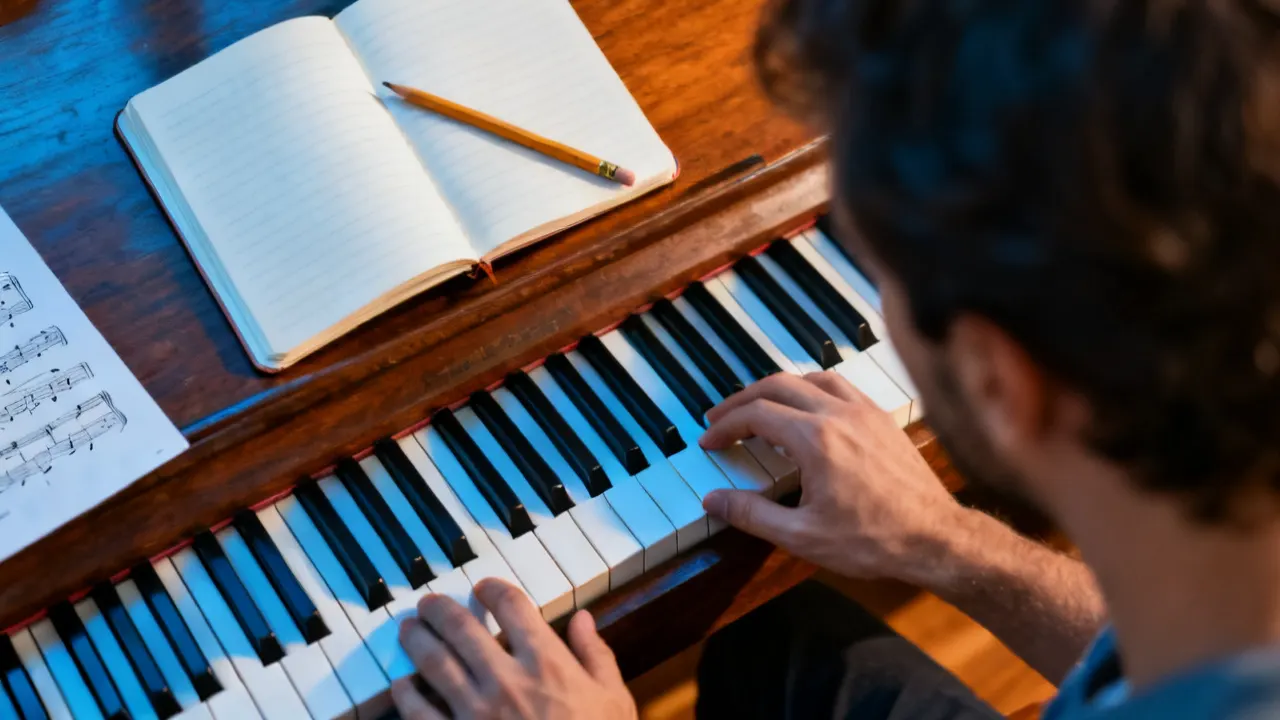
Take notes in a notebook. Write three lines after each lesson: what I learned, what was hard, what I will repeat.
Repeat before moving on. If a lesson feels shaky, repeat it the next day. Finishing a course is not the goal; being able to play is.
Play the same piece several days in a row. Repetition is how your hands learn. Aim for slow accuracy first and speed later.
Pair it with songs you like. If the course material feels dry, add a simple arrangement of a favorite tune to the end of each session. See easy piano songs for beginners for ideas.
Why adults drop courses, and how to avoid it
Most adults who stop a course do not stop because it is too hard. They stop because life interrupts and the course makes it hard to resume. A week off becomes a month. To protect yourself, choose a course that lets you jump back in without guilt, with short lessons you can repeat. Set a minimum viable session, such as five minutes of review, for days when you are tired. If you miss a week, do not restart from the beginning; replay the last lesson you felt comfortable with and move forward.
It also helps to decide in advance what finishing looks like. For example: "By the end of this course I will play three simple songs with both hands." A concrete finish line makes it easier to see progress and to celebrate it. Write the goal on a card and put it on the music stand.
Open play alongside the course
Courses give structure, but the piano rewards a little play. At the end of each session, give yourself two minutes to explore. Hold a chord and listen to how it rings, try making up a melody on the black keys, or pick out the first notes of a song you love by ear. This open play builds your ear and keeps the instrument fun. It also shows you how much you have learned, because notes that confused you in week one now make sense.
Questions to ask before you enrol
- Can I see the lesson list or syllabus?
- When do I play my first full song?
- How long is a typical lesson?
- What if I already know the basics?
- What happens after the beginner level?
- How does billing work and how do I cancel?
If the answers are vague, look elsewhere.
A realistic timeline
With about fifteen minutes on most days, an adult can usually finish a first module in one to two weeks, play simple melodies with both hands within a month or so, and start accompanying songs with chords in the second or third month. Everyone is different, and the pace depends on your history with music, your practice habits and your patience. For a deeper look at this question, read how long it takes to learn piano.
After the beginner course
When you finish, you will know the keys, play simple songs with two hands and understand basic chords. The next step is usually one of three directions: deeper technique with a teacher, a wider repertoire with a songbook, or a specific style such as pop, jazz or classical. Decide what excites you most, and choose the next course accordingly.
Summary
The best piano course for beginners is the one that keeps you at the keyboard, builds in small steps, puts songs early, and respects your time. Use the yardstick curriculum, read the syllabus before you pay, and test the first few lessons. Then protect ten to fifteen minutes a day, and let the course do the rest.