Best App to Learn Piano: A Checklist for Adult Beginners
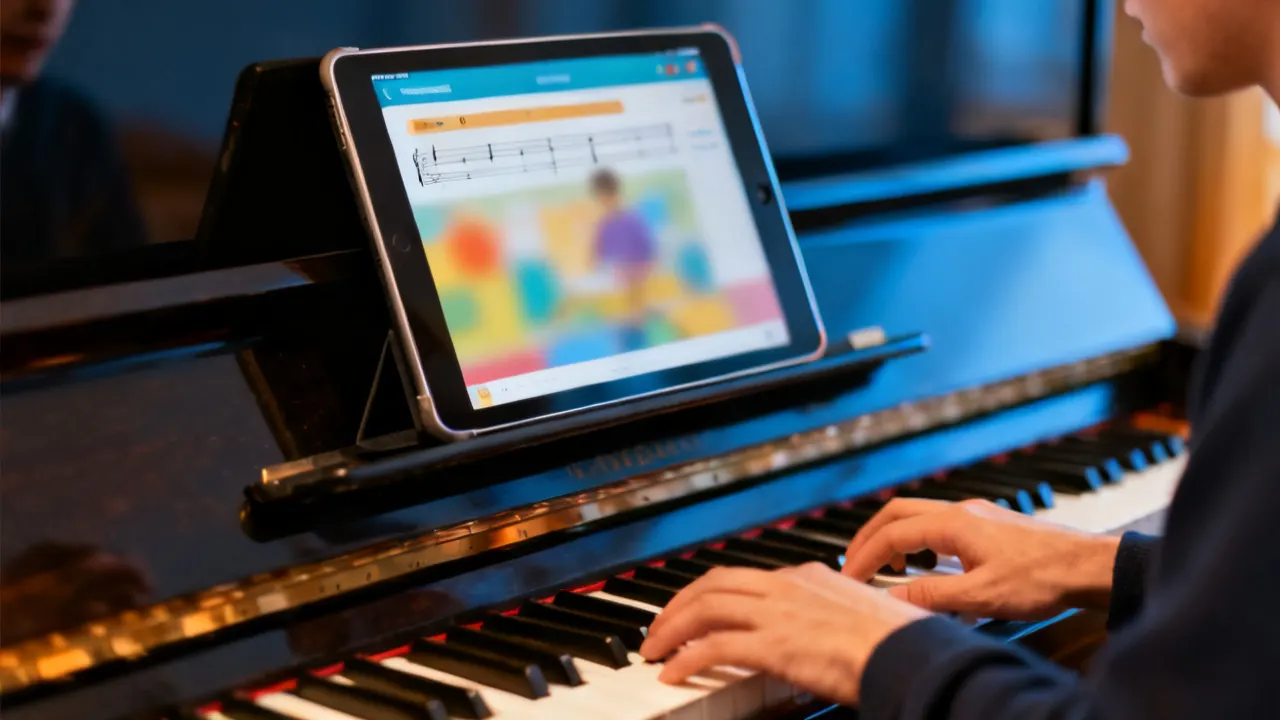
The best app to learn piano is the one that gets your hands on real keys in short, structured sessions and makes tomorrow's practice obvious. Plenty of apps look beautiful in a store screenshot and leave you with no skills a month later. This guide gives you a checklist you can run on any piano learning app, explains what to expect from each type, and shows where Keyora fits.
We will not rank competitors by name or promise a particular result. The goal is to help you choose with your eyes open.
The four types of piano apps
Game-style apps. Falling notes you tap along with. They are fun and teach rhythm and note recognition, but you may end up good at the game and not at the instrument.
Video lesson libraries. A teacher on screen with a catalogue of lessons. Quality can be excellent, but you pick your own path, which many beginners find overwhelming.
Sheet-music and songbook apps. Large collections of arrangements. Great once you can read and have a goal, less helpful for a first-time player.
Guided path apps. They ask about your level and goals, then build a sequence of courses, songs and exercises. This is the approach most suited to adult beginners who want less decision-making.
Most good products blend two or three of these. The question is which one is at the center.
An eight-point checklist
1. It starts with you
Does the app ask about your experience, your goals and the time you have? If a beginner and someone who reads music get the same first lesson, one of them is wasting time.
2. There is a clear path
Look for numbered courses or a visible plan. You should know what you will learn this week and what comes after.
3. It gets you playing songs early
Within the first couple of weeks you should be playing something recognizable, even if it is a simplified arrangement. A songbook of popular tunes is a strong sign.
4. Sessions are short
Adults need sessions of five to fifteen minutes. If the minimum unit is a forty-minute lesson, the app is built for a different life.
5. It teaches rhythm, not only notes
Rhythm is what makes a melody sound like a melody. Look for exercises that train counting and steady tempo.
6. It builds reading gradually
You do not have to read music perfectly on day one. Good apps introduce note names, then simple notation, then chords. Our guide to reading piano notes explains the path.
7. It keeps you coming back kindly
Reminders, challenges and visible progress can help. Streak shaming and endless notifications do not. You want encouragement, not guilt.
8. It is honest about what it is
An app can teach beginner skills and keep you practicing. It cannot see your wrist or correct your posture the way a teacher in the room can. Trust products that say so.
Red flags
- Promises of fluency in days or guarantees about speed. Everyone learns at a different pace.
- No way to see the lesson plan before committing.
- Lessons that never leave the screen: no songs, no real playing.
- Heavy gamification with little music inside.
- Unclear billing or hard-to-find cancellation instructions. Always read how a subscription renews before you start.
Where Keyora fits
Keyora is a guided path app for adults starting from scratch. It begins with a short quiz about your level, your goals and the time you can give. From your answers it builds a personalized plan with step-by-step courses, a songbook of popular songs to play and challenges for sharpening your skills. The idea is simple: spend your ten minutes playing, not choosing.
It is a good fit if you like structure, want songs early, and prefer not to build your own curriculum from a library. If you already know you want to study classical technique with a live teacher, an app is a supplement rather than a replacement.
How to test an app in a week
Before you commit to anything long term, run this seven-day test.
- Day 1: Complete the setup and check whether the plan makes sense for your level.
- Days 2 to 4: Practice ten minutes a day. Notice whether you always know what to do next.
- Day 5: Try a song or challenge. Is it fun? Is it at the right difficulty?
- Day 6: Record yourself playing something from day two and compare it with day six.
- Day 7: Ask yourself if you want to open it again tomorrow.
If you feel progress and curiosity, the app is working. If you feel confusion or boredom, move on without guilt.
Questions to ask before you subscribe
Write these down and answer them from the app's own pages before you enter a card.
- What exactly will I be playing after two weeks? A specific answer such as "a simple melody with both hands" is better than "you will be amazing".
- What happens when I get stuck? Look for a way to repeat, slow down or revisit a lesson without feeling punished.
- How does the plan change if I miss a few days? Real life interrupts. A good plan resumes where you left off.
- What does it cost after the introductory period? Check the renewal price and the cancellation steps in plain sight.
- Will it still help me in six months? An app that only covers the first two weeks is a short story. Look for courses that keep going into chords, rhythm and songs.
A confident product answers all of these clearly. If you have to hunt for answers, treat that as information.
App, course or teacher?
An app is cheapest per month and easiest to fit into your day. A video course gives you more depth on a specific method. A teacher gives you tailored feedback. For many adult beginners, the best answer is an app or course for daily practice and an occasional lesson for technique. If you want to compare formats, read online piano lessons for adults.
Making any app work harder for you
- Put the keyboard where you can see it.
- Practice at the same time each day.
- Use headphones so the volume is never a reason to skip.
- Keep a one-line log: what you worked on, what to do next.
- Play something just for fun once a week, whether or not the app suggests it.
The app is a tool. The progress comes from the habit around it.
Bottom line
The best app to learn piano for an adult beginner is personalized, structured, song-oriented, and kind about your time. Run the checklist, test for a week, and choose the one that makes you want to sit down tomorrow. If that sounds like what you need, take a look at what Keyora offers adult beginners using the button on this page, and see whether its plan matches your goals.